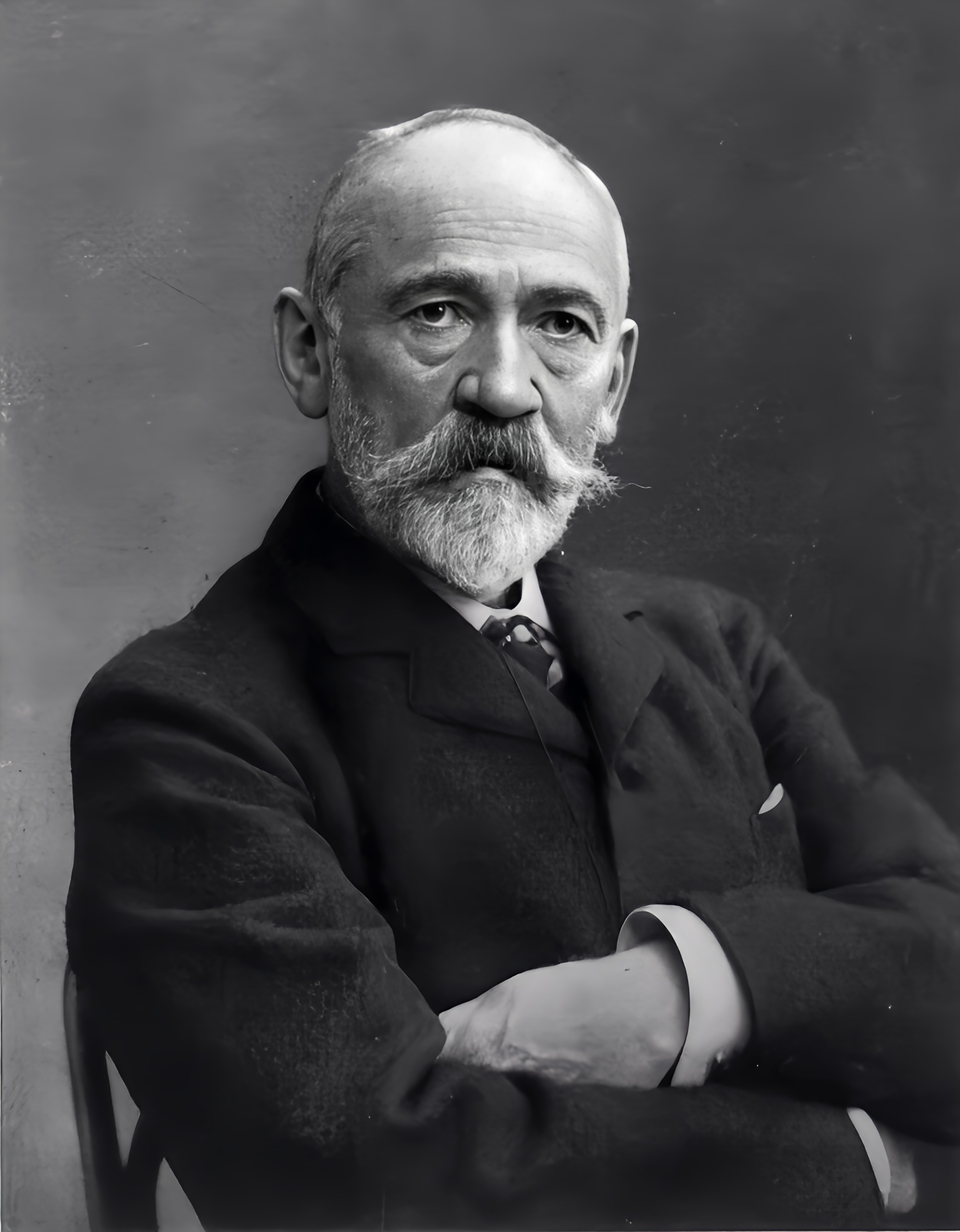
Ward's significance is not merely biographical. His career marks a turning point in American public art: the transition from Neoclassical marble allegory to bronze realism, from Roman idealism to figures recognizable as American subjects on American ground. He accomplished this through forty years of continuous production in New York, through institutional leadership as co-founder of the National Sculpture Society, and through direct mentorship of sculptors who would define American public art through the first quarter of the twentieth century.
Urbana, Ohio
Ward was the fourth of eight children born to John Anderson Ward and Eleanor Macbeth Ward in Urbana, Ohio, on June 29, 1830. His paternal grandfather, Colonel William Ward, had founded the city of Urbana in 1805. As a child he fashioned small figures and animals from mud near the creeks on his father's farm. At age eleven he worked in the pottery workshop of a local craftsman named Miles Chatfield, where he learned wheel-turning and bas-relief decoration on clay surfaces.
After attending a sculpture exhibition in Cincinnati in 1847, Ward felt discouraged about an artistic career. When his family suggested medicine instead, he enrolled in medical study but contracted malaria and was forced to abandon it. He moved to Brooklyn to live with his older sister Eliza and her husband Jonathan Wheelock Thomas, and there his formal training began.
Apprenticeship Under Henry Kirke Brown
From 1849 to 1856, Ward trained in the Brooklyn studio of sculptor Henry Kirke Brown (1814-1886). The apprenticeship established the philosophical foundation of his entire career. Brown was a deliberate dissenter from the dominant tradition of the era, in which American sculptors traveled to Rome or Florence to study classical models and produced allegorical figures in white marble. Brown argued that American sculpture should depict American subjects, should be cast in bronze rather than carved in marble, and should be trained and produced domestically.
Ward absorbed these principles entirely. He never studied abroad during his training years; his first trip to Europe came in 1872, when he was already forty-two years old and an established sculptor. He spent seven years with Brown before striking out independently, a longer apprenticeship than most of his contemporaries served.
His most significant contribution during those years was his work on Brown's bronze equestrian statue of George Washington, unveiled in Union Square, New York, on July 4, 1856. Brown acknowledged Ward's contribution in an unusual gesture: he inscribed Ward's name on the base of the monument alongside his own, a credit rarely extended to an assistant. That inscription at Union Square is Ward's first public attribution in New York City.
A Philosophy of American Realism
When Ward established his own studio in New York in 1861, he carried Brown's principles forward as a working methodology. His practice rested on four consistent commitments.
The first was the study from life. Ward modeled from living subjects whenever possible. For subjects who were deceased, he used death masks, photographs, and firsthand accounts. When no adequate source existed, he sought one out. For his monument to Henry Ward Beecher, unveiled in 1891, Ward made the death mask himself on the day Beecher died, March 8, 1887.
The second was the accuracy of observed detail. His most documented demonstration of this commitment was his preparation for The Indian Hunter. Ward had modeled a small version of the sculpture around 1858-1860 with what he recognized were Caucasian facial features on the figure. Before completing the full-scale work, he traveled to Dakota Territory in 1864 specifically to observe and sketch Indigenous peoples and produce wax studies from life. He then corrected the facial features in his full-scale model before casting. The trip delayed the work by several years.
The third was the rejection of theatrical gesture. Lorado Taft, whose 1903 History of American Sculpture remains the standard account of the era, described Ward's figures in terms his contemporaries would have recognized: "They stand firmly on their feet, and they make no gestures, no attempt to win us... you feel eternity in their attitudes, in their composure." Ward's portraits avoided the declamatory poses, billowing cloaks, and skyward gazes common in Neoclassical convention.
The fourth was bronze. With few exceptions, Ward worked exclusively in bronze throughout his career. It was both a practical and ideological choice: bronze withstands outdoor conditions indefinitely, can be cast in multiples, and was the medium of the ancient portrait bronzes he most admired.
The Indian Hunter (1869)
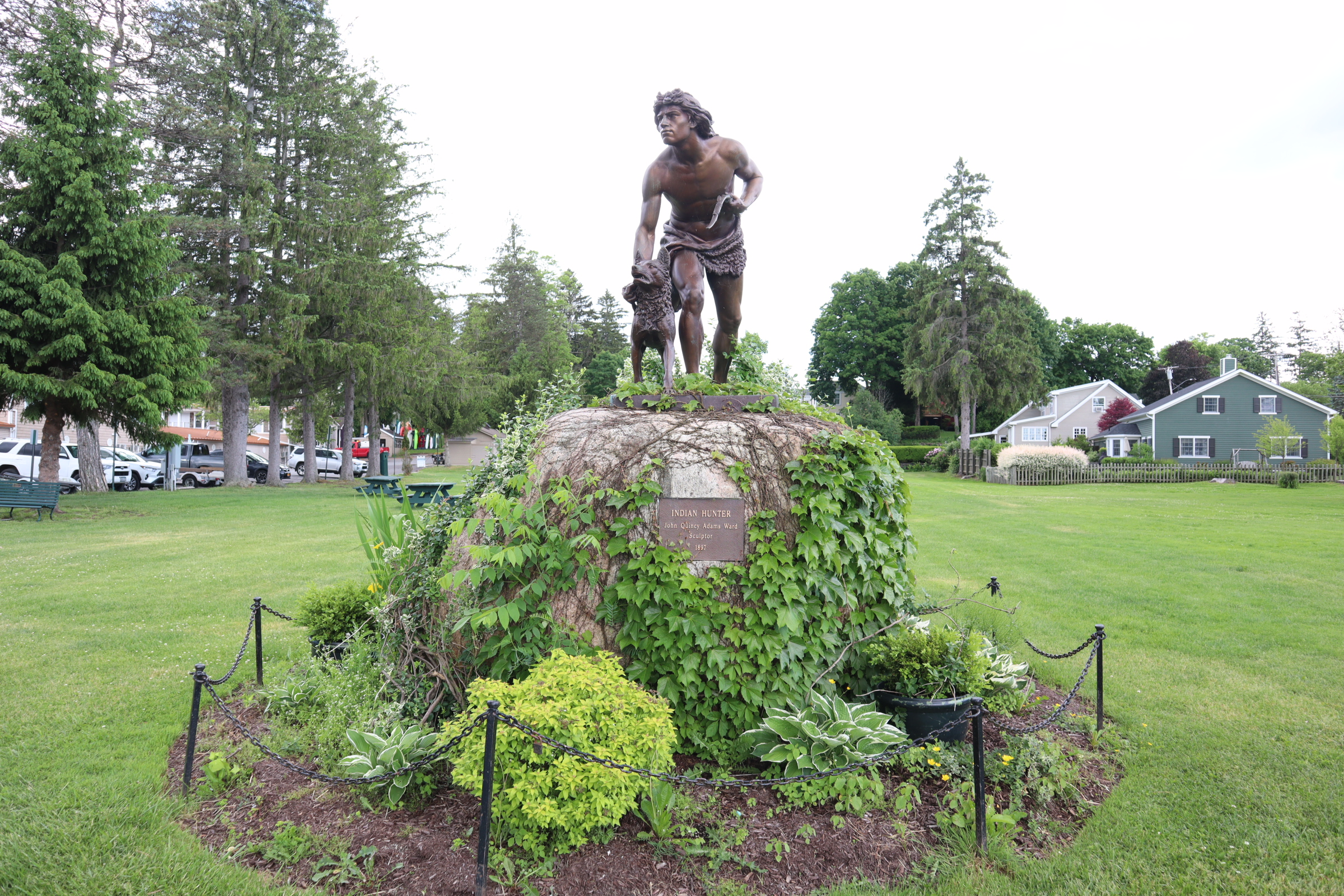
The Indian Hunter was unveiled in Central Park on February 4, 1869, the first sculpture by an American artist placed in the park. The full-scale bronze depicts an Indigenous man in a crouched position, one knee on the ground, holding a bow horizontally at his side while his dog presses close against his leg. The dog's posture mirrors the hunter's focus: both are fixed on a point just beyond the viewer's sight.
The commission arose after August Belmont, a Central Park Board Commissioner, saw Ward's small model and organized fundraising among approximately two dozen prominent New Yorkers, including architect Richard Morris Hunt. The full-scale bronze was exhibited at the Paris Exposition in 1867 before being presented to the city. It cost $10,000 to cast; the Rockport granite plinth was designed by architect Jacob Wrey Mould.
The work's reception was immediate. Daniel Chester French, who worked as Ward's special pupil in 1870 and credited his time in Ward's studio with having "influenced my whole life to a marked degree," wrote to Mrs. Ward after her husband's death: "I regard the Indian Hunter as among the very finest examples of modern sculpture. It is the more remarkable having been made at a time when the classic influence was so strong as almost to stifle originality and freshness in sculpture."
The Freedman (1863)
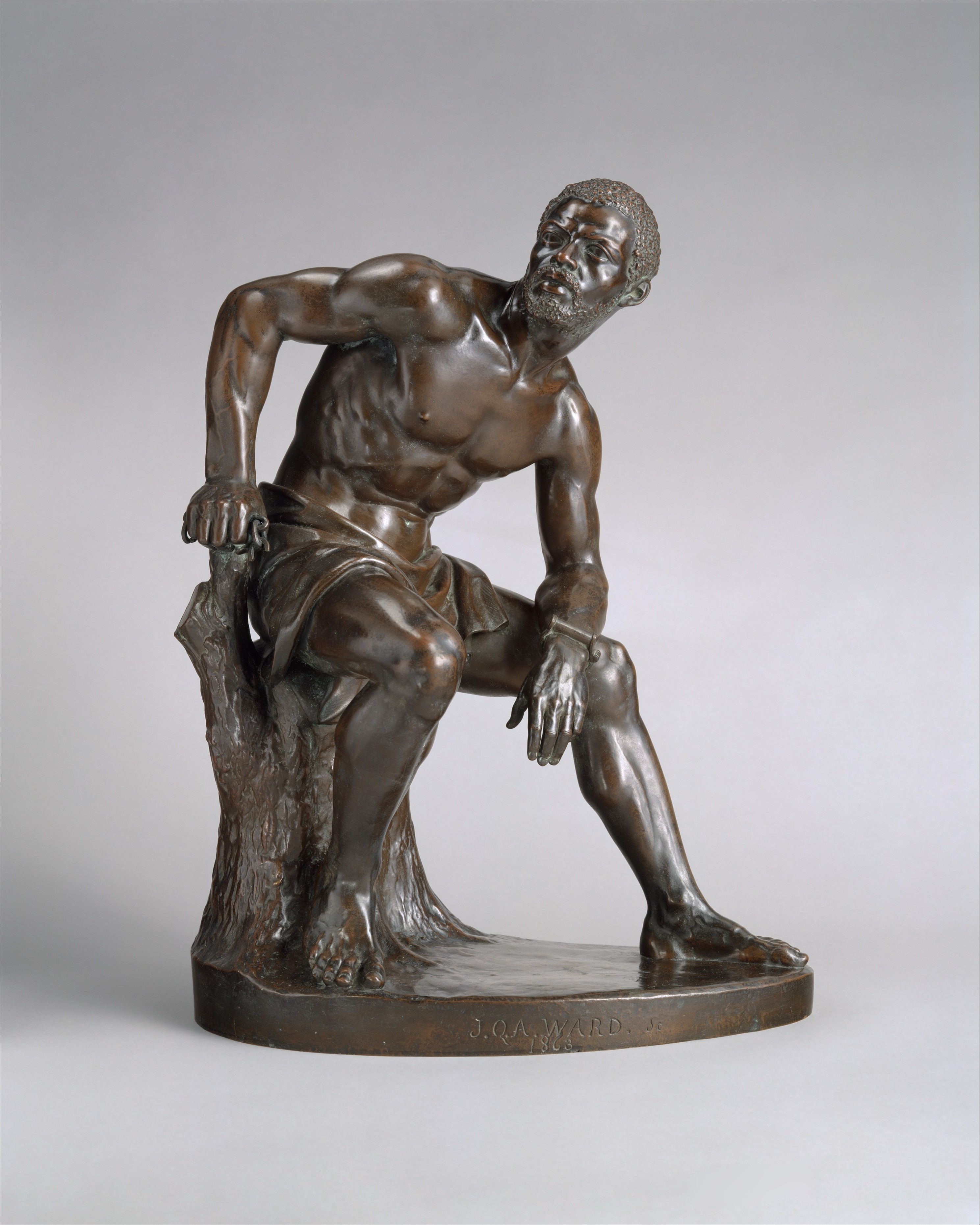
Modeled in 1863 and first exhibited as a plaster at the National Academy of Design that spring, The Freedman is among the first bronze statues of a Black person in American art. The sculpture depicts an African American man seated on a tree stump, his body coiled, left leg extended, right leg pulled up against the stump. He holds a broken shackle; a second shackle remains on his wrist.
Ward explained the figure's pose in precise terms: it was "calculated to express not one set free by any proclamation, so much as by his own love of freedom and a conscious power to break things." The work was modeled before the Emancipation Proclamation took effect. Ward located the act of liberation in the figure's own body and will rather than in an external authority.
The critic James Jackson Jarves, writing in the same decade, argued the work should be placed in the United States Capitol as a monument to American democracy.
One of the known casts, now at the Amon Carter Museum of American Art, bears a working manacle that can be opened and locked with a key, and is engraved with a memorial tribute to the 54th Massachusetts Volunteer Infantry, the regiment that suffered catastrophic losses at Fort Wagner on July 18, 1863. This inscription makes the Amon Carter cast the earliest known memorial to those soldiers. Six lifetime casts are documented. The Metropolitan Museum of Art, which received a cast in 1979, describes the figure as occupying "a transitional status between enslavement and full standing in citizenship and humanity."
New York: A City's Worth of Bronze
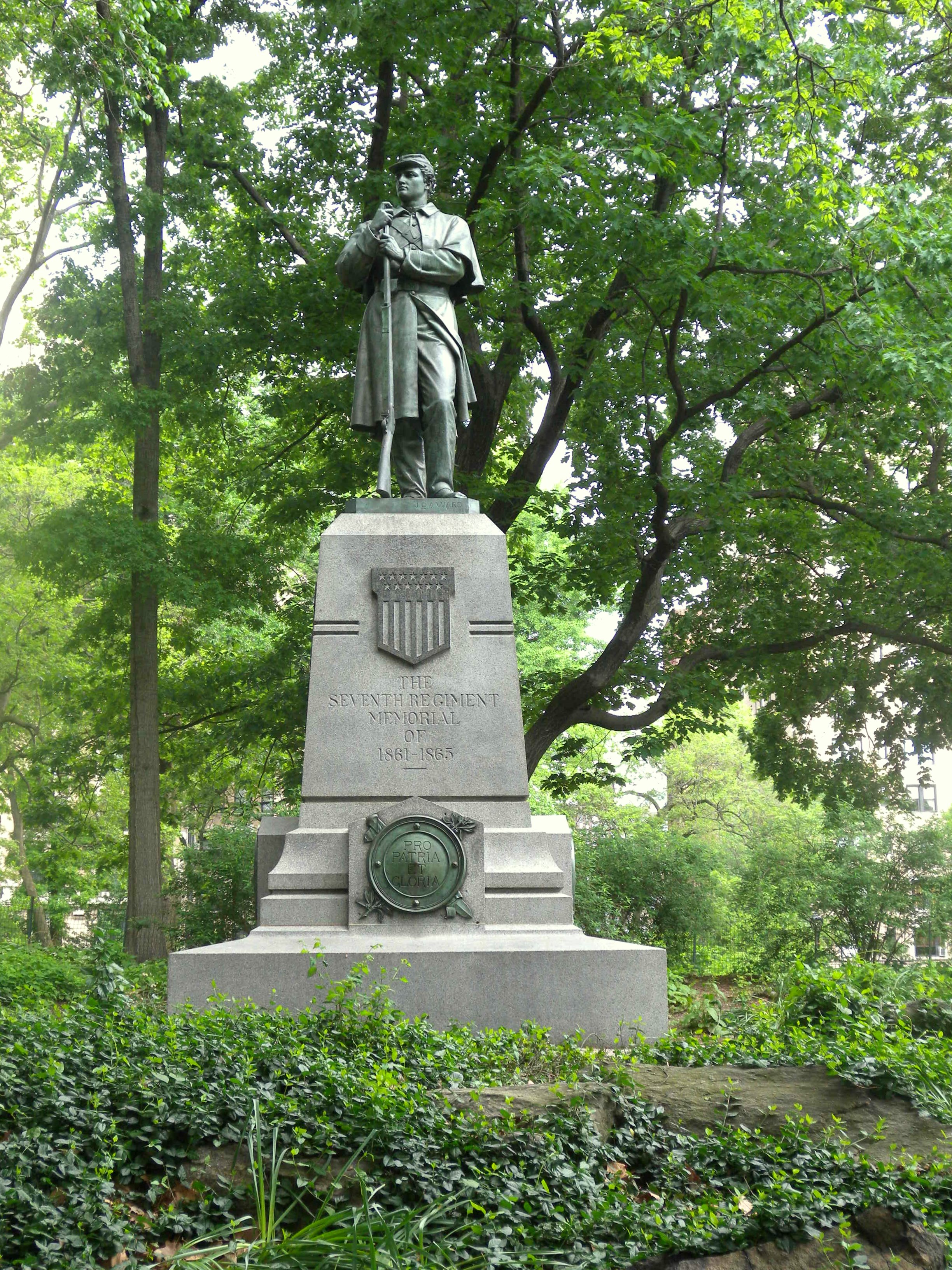
Ward's New York output over four decades constitutes an unusual concentration of public monuments in a single city. His works in Manhattan and Brooklyn include The Indian Hunter (Central Park, 1869); William Shakespeare (Central Park, Literary Walk, 1872); Seventh Regiment Memorial (Central Park, 1874); The Pilgrim (Central Park, Pilgrim Hill, 1885); William Earl Dodge (originally Herald Square, 1885; now Bryant Park); George Washington (Federal Hall, Wall Street, 1883); Alexander Lyman Holley (Washington Square Park, 1890); Horace Greeley (City Hall Park, 1890); Henry Ward Beecher (Borough Hall, Brooklyn, 1891; relocated to Cadman Plaza 1959); Roscoe Conkling (Madison Square Park, 1893); and the New York Stock Exchange Pediment (with Paul Wayland Bartlett, 1904).
This concentration reflects Ward's position in New York art life during the period. He served as president of the National Academy of Design from 1862 to 1874. He maintained his studio continuously in the city for fifty years. His institutional standing, combined with his reputation for reliable, high-quality work, placed him first in consideration for most significant New York commissions through the 1870s and 1890s.
Portraits in Bronze
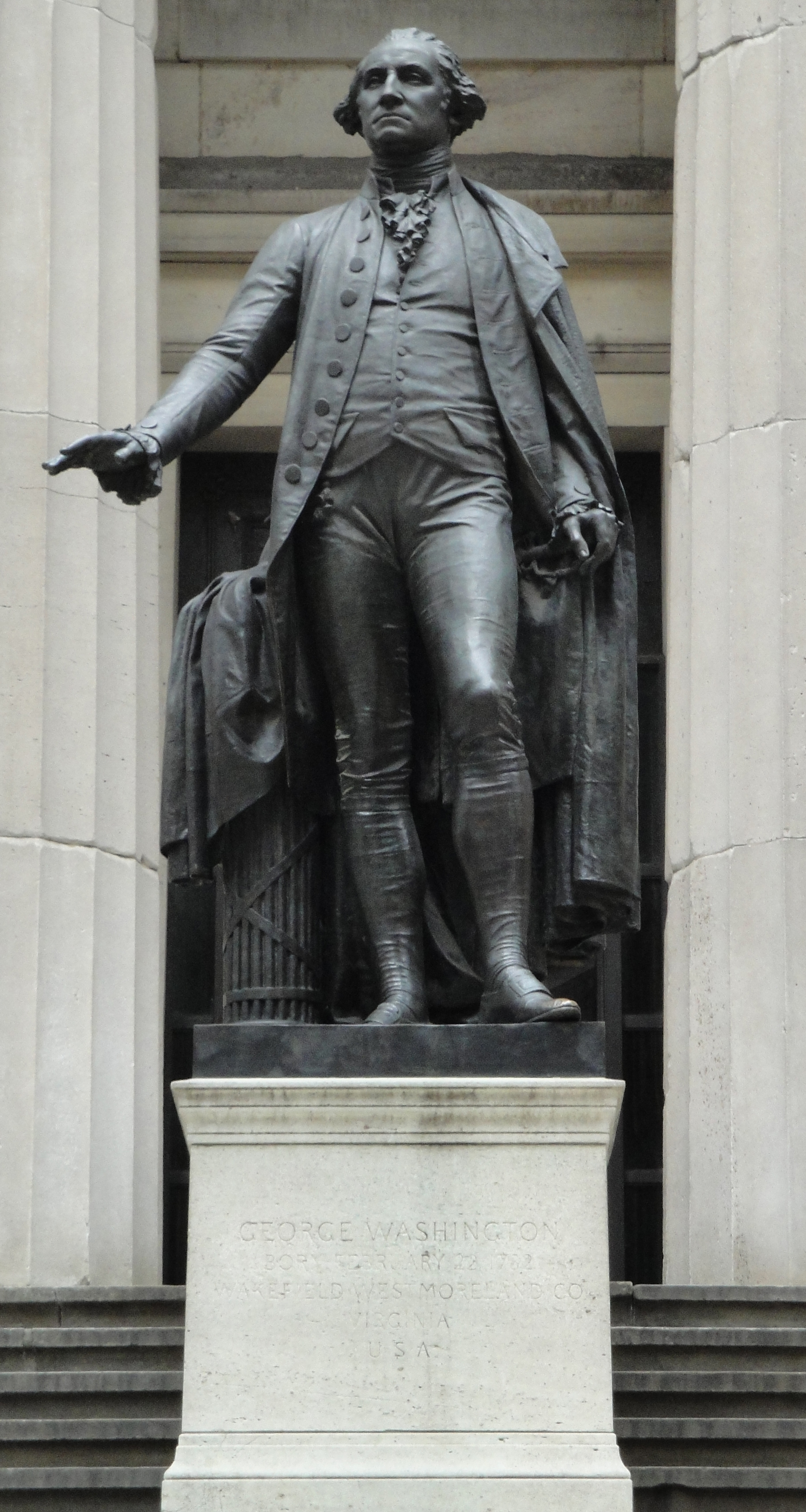
Four of Ward's New York portraits illustrate the range and consistency of his method.
The bronze of George Washington at Federal Hall (1883), with a pedestal designed by Richard Morris Hunt, depicts Washington at the moment after taking the oath of office, turning to acknowledge the crowd. Lorado Taft observed that Ward succeeded by presenting "not a domestic portrait but the great, legendary figure toward whom the whole country turned," and that the statue functioned as a symbol through "well-weighed omission" of specific personal detail.
Horace Greeley (1890), seated in a heavily fringed Victorian chair with a copy of the Tribune loose over his knee, was modeled eighteen years after Greeley's death, from photographs and firsthand accounts. Taft called it "the last word in faithful characterization."
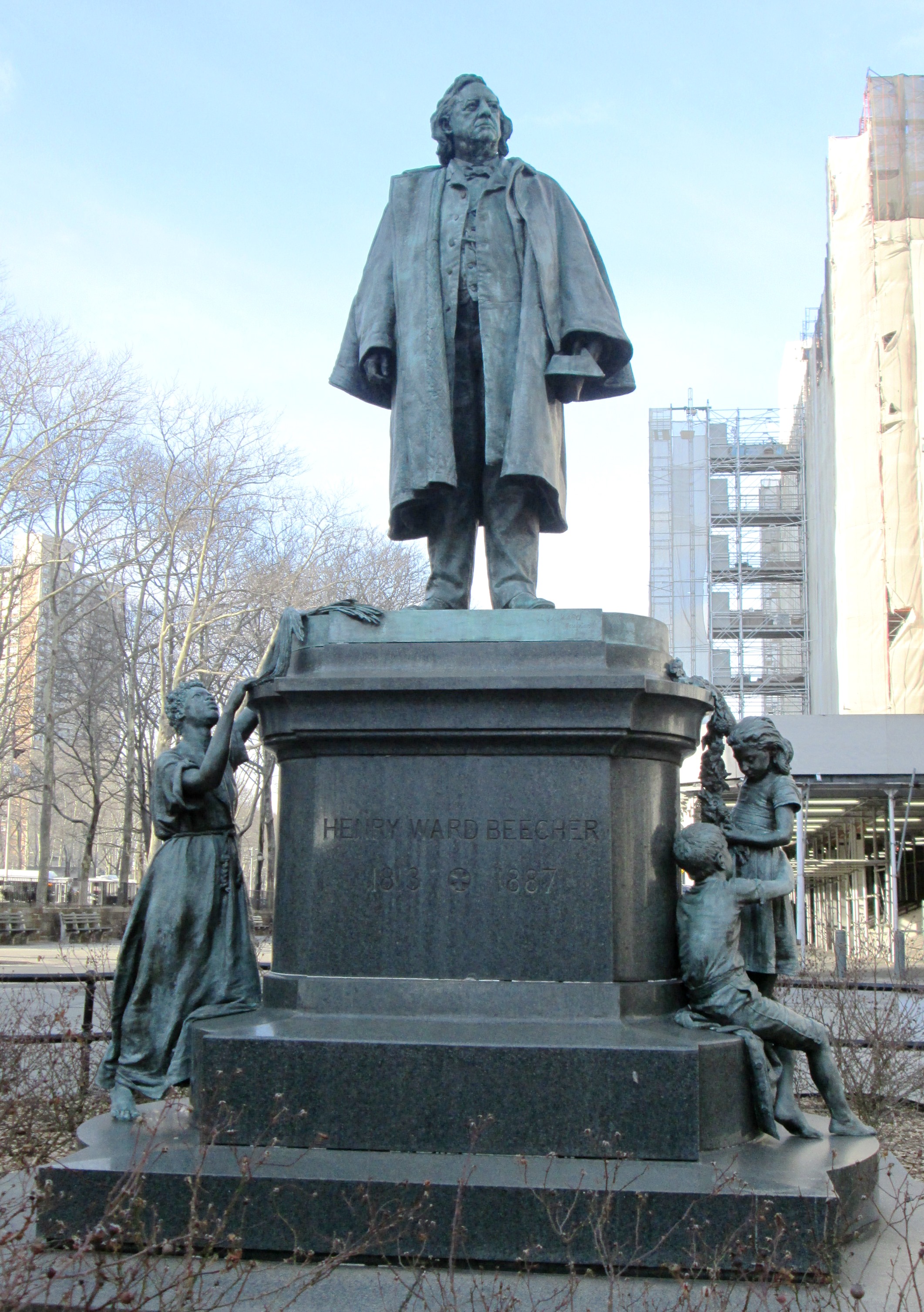
Henry Ward Beecher (1891) is the most compositionally elaborate of Ward's New York portraits. The central figure stands in an Inverness coat. At the pedestal's base, a young Black woman places a palm branch, and white children offer a garland on the opposite side. Ward made the death mask of Beecher on the day the minister died. Taft called it "one of the most impressive portraits in this country."
Roscoe Conkling (1893) at Madison Square Park depicts the former senator delivering a speech before the Senate, a pose requested by Conkling's widow. It was installed in early December 1893 without formal ceremony: workers hoisted the bronze onto its granite pedestal, and no dedication was held.
Beyond New York
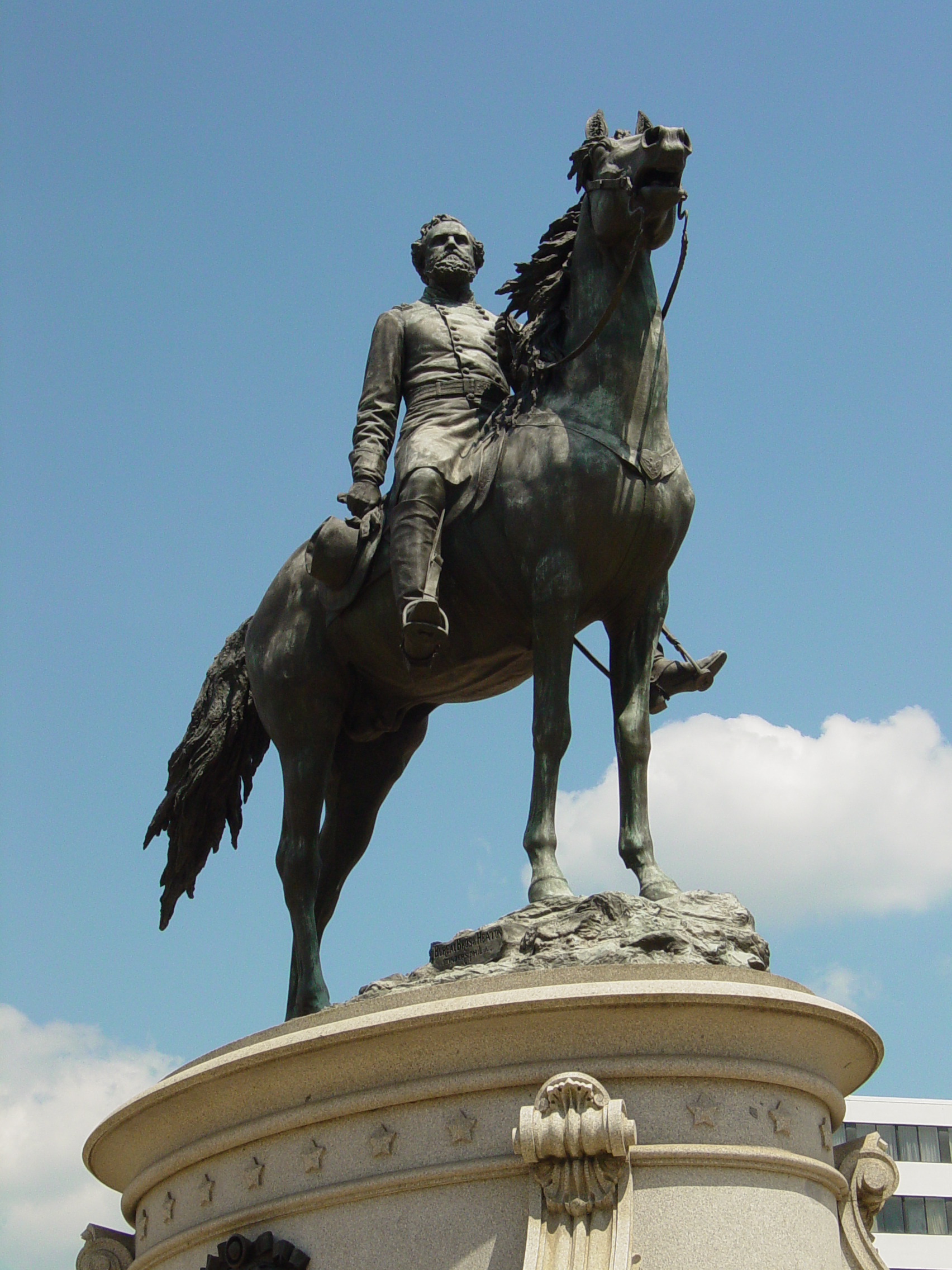
Ward received major commissions outside New York throughout his career. Several are among the largest and most technically demanding public works of the era.
The Good Samaritan Monument (1868) in the Boston Public Garden stands forty feet high and is the oldest monument in the garden. It commemorates the first public demonstration of ether anesthesia at Massachusetts General Hospital in 1846. Architectural elements were designed by William Robert Ware.
The Major General John F. Reynolds Monument (1872) at Gettysburg National Military Park was the first bronze statue placed at Gettysburg. The base, ten feet high and weighing twenty-three tons, was constructed from four bronze cannon barrels.
The Equestrian Statue of General George Henry Thomas (1879) at Thomas Circle in Washington, D.C., stands approximately thirty-two feet high, with horse and rider at roughly twice life-size. It was cast from captured Confederate bronze cannon. Ward worked on the commission for four years. A contractual specification required that three of the horse's four feet remain in contact with the ground throughout the composition. Approximately 50,000 people attended the 1879 dedication; President Rutherford B. Hayes accepted the statue on behalf of the nation.
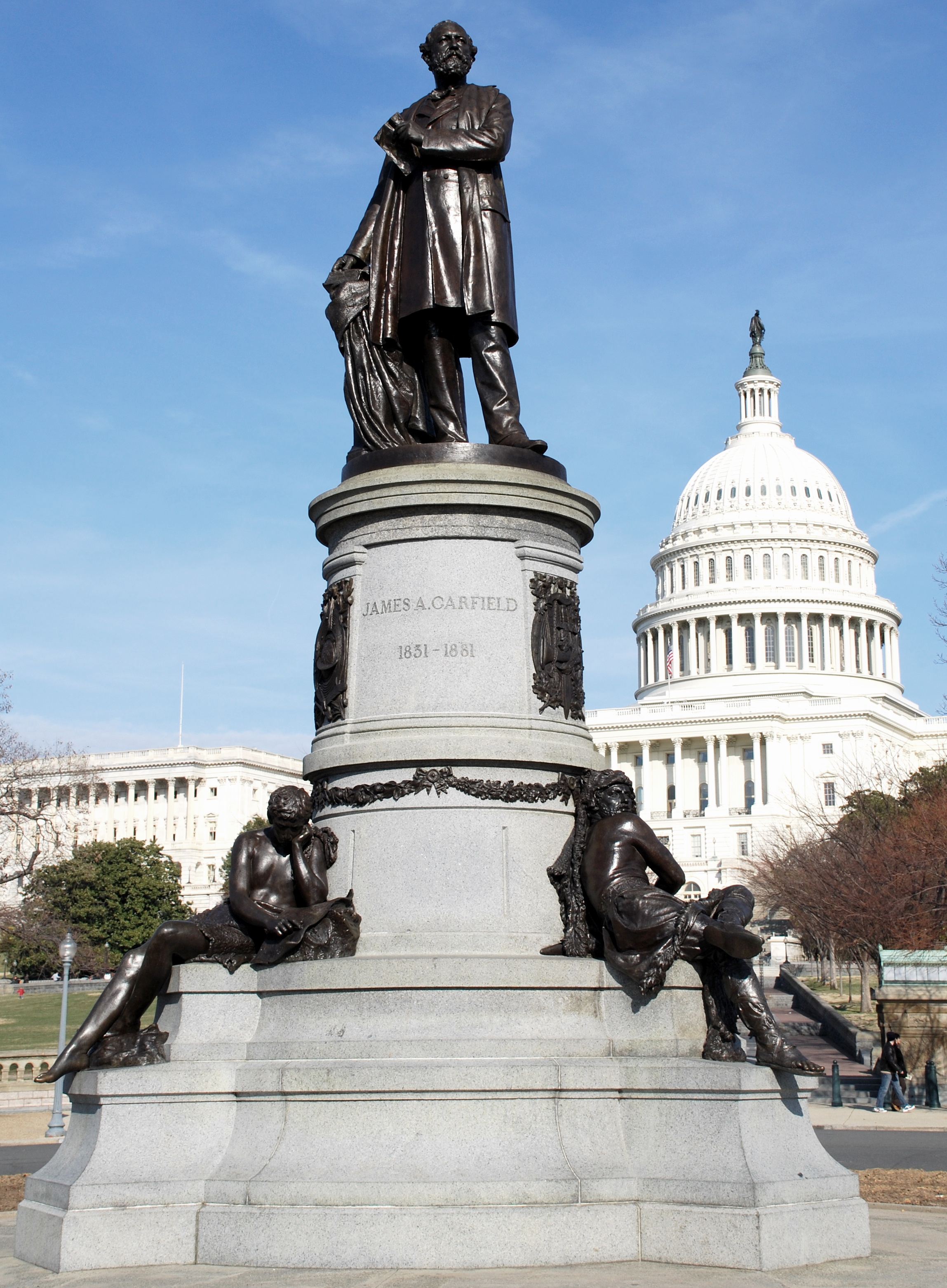
The James A. Garfield Monument (1887) on the Capitol grounds includes a central standing figure of Garfield in a long coat, flanked at the base of the pedestal by three allegorical bronzes representing his three careers: Teacher, Warrior, and Statesman. Richard Morris Hunt designed the pedestal. Ward and Garfield had been personal friends; contemporaries described the portrait as particularly lifelike. Total commission cost: $62,539. President Grover Cleveland, General Philip Sheridan, and members of the Supreme Court attended the unveiling.
Ohio
Ward's primary Ohio work is the bronze bust of Lincoln Goodale (dedicated September 26, 1888), installed in Goodale Park in Columbus. The bust, approximately three feet in height, cost $5,470 and is inscribed "Ohio sculptor J.Q.A. Ward." It remains in place.
Ward's gravesite is in Oakdale Cemetery in Urbana, Ohio. At his own request, a copy of The Indian Hunter marks the grave. His Urbana home is listed on the National Register of Historic Places. His sketchbooks and papers are held at the Albany Institute of History and Art (Collection CM 544).
The National Sculpture Society
Ward co-founded the National Sculpture Society in 1893 and served as its first president until 1905. It was described at its founding as "the first organization of professional sculptors formed in the United States." Co-founders included Daniel Chester French, Augustus Saint-Gaudens, Herbert Adams, Paul Wayland Bartlett, Karl Bitter, Attilio Piccirilli, and architects Richard Morris Hunt and Stanford White.
The Society's stated purpose was to raise the professional standing of sculptors and to promote figurative and realistic work. Ward's forty-year dominance of New York commissions made him the natural choice for its first presidency. He served for twelve years.
Ward and Richard Morris Hunt
Richard Morris Hunt (1827-1895) was Ward's most frequent professional collaborator and closest personal friend in the art world. Hunt designed Ward's home and studio on 52nd Street in Manhattan in 1882. Their working relationship spanned at least nine major commissions over two decades.
The division of labor between them was consistent: Hunt designed the pedestal, including inscriptions and bas-relief panels; Ward executed and cast the sculptural figures. This collaboration produced some of the most formally unified monument compositions of the era, in which pedestal and figure were conceived together rather than as separate elements. Collaborative works included the Seventh Regiment Memorial (1874), George Washington at Federal Hall (1883), The Pilgrim (1885), William Earl Dodge (1885), the Garfield Monument (1887), Horace Greeley (1890), and the Henry Ward Beecher Monument (1891). Hunt died in 1895; Ward continued for fifteen more years without a collaborator of equivalent standing.
Legacy
Ward died at his New York home on May 1, 1910, at age seventy-nine.
His direct influence on the generation that followed him was concrete. Daniel Chester French, who worked as Ward's special pupil in 1870 and later created the seated Lincoln at the Lincoln Memorial (dedicated 1922), wrote that Ward's guidance "influenced my whole life to a marked degree." Ward also advocated for younger sculptors in institutional settings: he is credited with promoting Augustus Saint-Gaudens for major commissions during the period when Saint-Gaudens was establishing his reputation.
Ward was elected to the National Academy of Design in 1862. He served as president of the National Academy from 1862 to 1874. He taught sculpture at the Metropolitan Museum of Art from 1888 to 1889 and delivered lectures at Harvard University in 1893. He was a founding trustee of the American Academy in Rome and a trustee of the Metropolitan Museum of Art.
No account of American public sculpture in the second half of the nineteenth century can omit him. His output from 1861 to 1910 constitutes the most sustained single-sculptor contribution to the American public monument in the history of that era. The bronze figures he placed across New York, Washington, Boston, Hartford, Newport, Brooklyn, and Gettysburg remain in their original locations. The Indian Hunter in Central Park still draws visitors who do not know his name.
Major Works: Reference
| Work | Year | Location | Notes |
|---|---|---|---|
| The Freedman | 1863 | Metropolitan Museum of Art; Amon Carter Museum; multiple casts | Among first bronzes of a Black person in American art |
| Good Samaritan Monument | 1868 | Boston Public Garden, Boston, MA | 40 ft.; oldest monument in the garden; commemorates ether anesthesia |
| The Indian Hunter | 1869 | Central Park, New York City | First sculpture by an American placed in Central Park |
| Matthew Perry | 1869 | Touro Park, Newport, RI | Pedestal by Richard Morris Hunt |
| William Shakespeare | 1872 | Central Park, Literary Walk, New York City | Commissioned by the Century Association |
| Gen. John F. Reynolds | 1872 | Gettysburg National Military Park, PA | First bronze at Gettysburg; base cast from four cannon barrels |
| Seventh Regiment Memorial | 1874 | Central Park, New York City | Civil War soldier; pedestal by Hunt; model was actor Steele MacKaye |
| Israel Putnam | 1874 | Bushnell Park, Hartford, CT | First of six Revolutionary War memorials Ward executed |
| Gen. George Henry Thomas | 1879 | Thomas Circle, Washington, D.C. | Equestrian; 32 ft. high; cast from Confederate bronze cannon |
| Yorktown Victory Monument | 1881 | Colonial National Historical Park, Yorktown, VA | Liberty/Victory figure; original destroyed by lightning 1942 |
| George Washington | 1883 | Federal Hall, Wall Street, New York City | Pedestal by Hunt; ~12 ft. bronze figure |
| The Pilgrim | 1885 | Central Park, Pilgrim Hill, New York City | Pedestal by Hunt with four bas-reliefs |
| William Earl Dodge | 1885 | Bryant Park, Manhattan (originally Herald Square) | Pedestal by Hunt included a temperance drinking fountain |
| James A. Garfield Monument | 1887 | Capitol grounds, Washington, D.C. | Three allegorical pedestal figures; pedestal by Hunt; cost $62,539 |
| Lincoln Goodale (bust) | 1888 | Goodale Park, Columbus, Ohio | Ward's primary Ohio work; inscribed "Ohio sculptor J.Q.A. Ward" |
| Alexander Lyman Holley | 1890 | Washington Square Park, Manhattan | Pedestal by Thomas Hastings |
| Horace Greeley | 1890 | City Hall Park, Manhattan | Seated figure; pedestal by Hunt |
| Henry Ward Beecher | 1891 | Cadman Plaza, Brooklyn (originally Borough Hall) | Death mask made by Ward on day of Beecher's death; pedestal by Hunt |
| Roscoe Conkling | 1893 | Madison Square Park, Manhattan | Installed without formal ceremony |
| NYSE Pediment | 1904 | New York Stock Exchange, Broad Street, Manhattan | With Paul Wayland Bartlett; carved by Piccirilli Brothers |
Sources: Lorado Taft, The History of American Sculpture (1903); Metropolitan Museum of Art, "Henry Kirke Brown and John Quincy Adams Ward: Realism in American Sculpture"; Albany Institute of History and Art, Collection CM 544; Amon Carter Museum of American Art press files; NYC Parks monuments database; Wikipedia (J.Q.A. Ward, individual monument articles). All photographs from Wikimedia Commons; public domain.